It all started with a comment under a YouTube video.
I was watching a conversation about writing, the kind where the "story recipe" comes up for the hundredth time: hero, goal, obstacle, transformation. You know it. I know it by heart, because I make a living from that recipe: I write treatments, and this pattern sits in every other brief. And suddenly, in the comments, someone writes something like this: that recipe is just the Western version of storytelling. In Asia there is kishōtenketsu, and it's my favorite.
I stopped and decided to dig deeper into the ways a story can be built.
I took one seed of a plot and ran it through different structures.
The seed goes like this: a woman who has lived by a river her whole life decides to find its source.
The version we all know: the three-act structure
Act one: she decides to find the source and sets out.
Act two: obstacles, a storm, a lost trail, an injury, a moment of doubt.
Act three: the last mountain pass, the source, triumph, a tear.
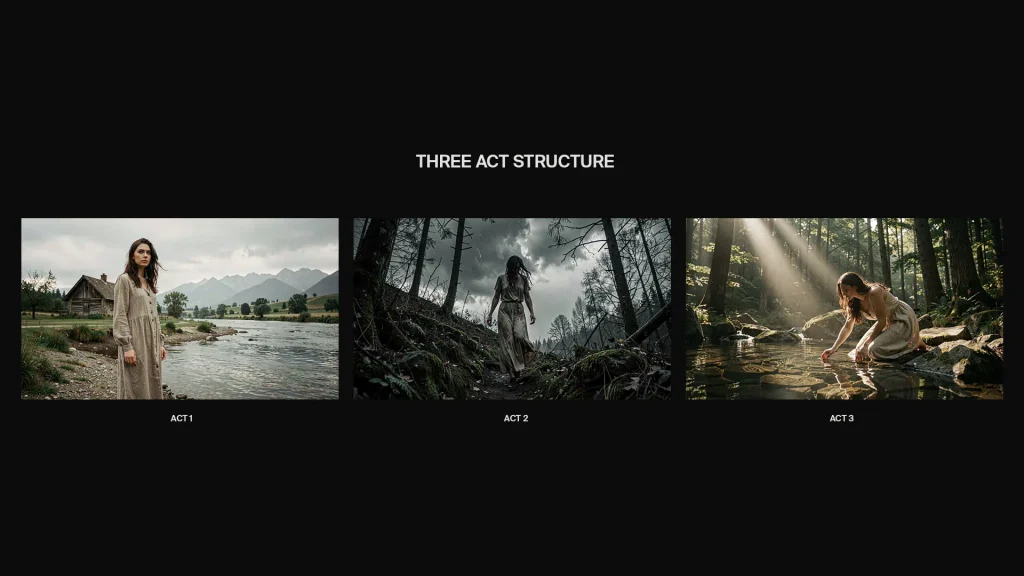
Does it work? It works. Aristotle laid it out over two thousand years ago, and Hollywood still hasn't found a reason to change anything. Desire, obstacle, resolution. The problem is that the audience knows this shape so well they can feel the third act before the first one is over.
Kishōtenketsu, or a story without an enemy
And here comes the structure from that comment. Four movements:
Ki: we meet the woman and her everyday life by the water.
Shō: she walks upstream, the landscape slowly changing.
Ten: she reaches the source and it turns out to be a barely visible trickle of water seeping from under a stone. Smaller than a puddle.
Ketsu: the mighty river and that tiny thing, placed side by side.

Nobody fights anybody. There is no enemy, no climax, no victory. Meaning is born from contrast, and the rest is assembled by the viewer.
Kishōtenketsu is above all a compositional scheme: of a four-line poem, of a four-panel manga. But as a tool? Gold.
The fairy tale according to Propp
The Russian folklorist Vladimir Propp analyzed a hundred folk tales and discovered that they are all made of the same building blocks, arranged in the same order. Our story in this edition:
The woman feels a lack; she wants to know where the river comes from;
She receives an interdiction ("don't go there") and passes the donor's test: an old ferryman checks whether she is ready before giving her advice or an object;
On the way she passes a false hero and faces an antagonist (a mountain spirit?);
She returns transformed, recognized by a token: something that proves she was there.
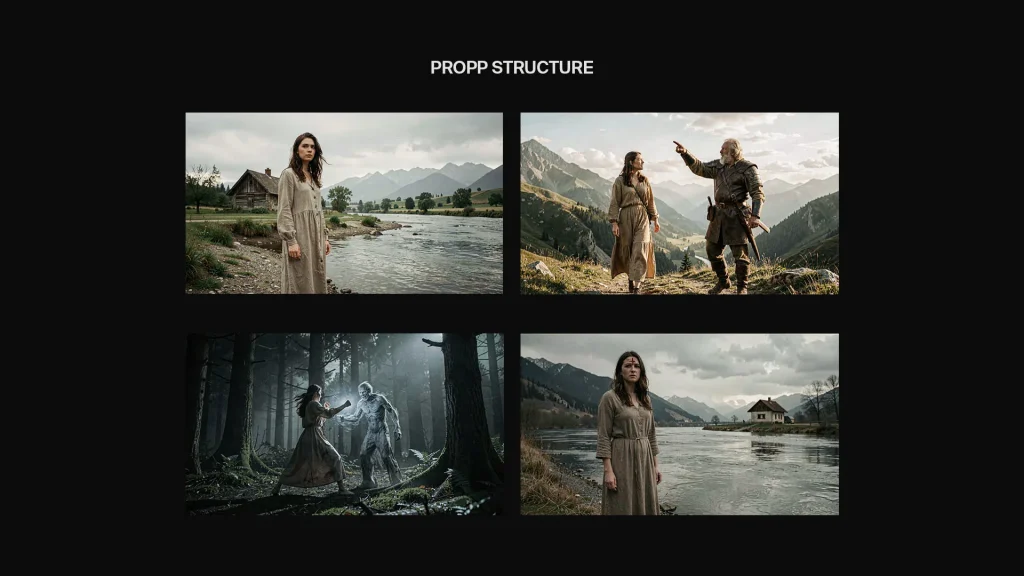
Sounds like a fairy tale you've known since childhood? Exactly, because it's the same shape of tension as the three-act structure, only broken down into its prime factors. Propp doesn't give us a different way to build a story; he gives us a box of ready-made parts. Sometimes it's worth reaching for them deliberately, especially when a brand wants to sound timeless.
The ring: the end is the beginning
Ring composition works like a mirror: A-B-C-B-A. In our case it looks like this:
A: A hand dipped in the water by the house
B: Morning on the road
C: Reaching the source
B: Afternoon on the way back
A: A hand dipped in the water
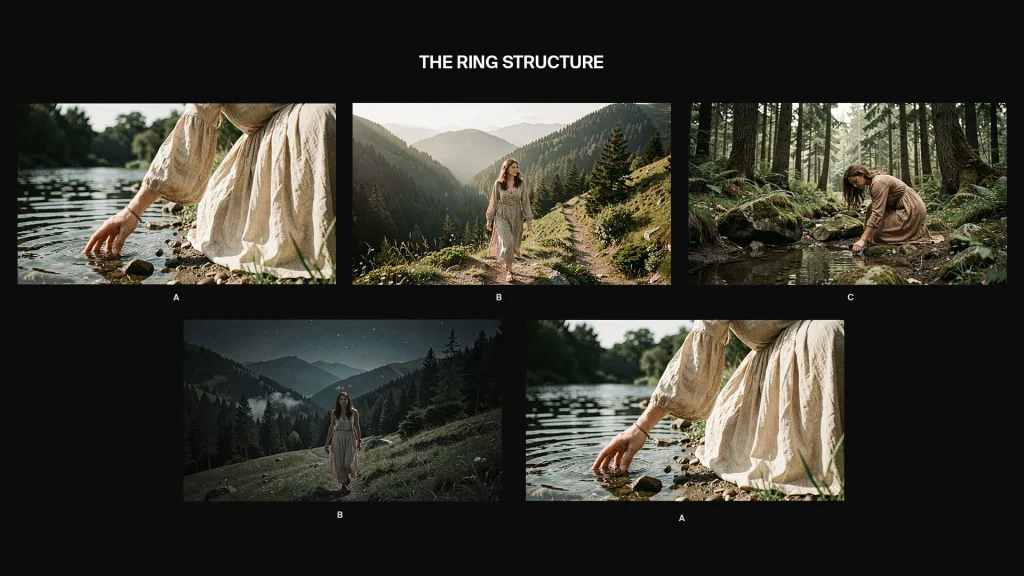
This is how the old epics were built; Homer did it constantly. In video it's a brilliant device: a visual bookend, symmetry of shots, the center of gravity exactly at the film's midpoint. The viewer feels the order even if they can't name it.
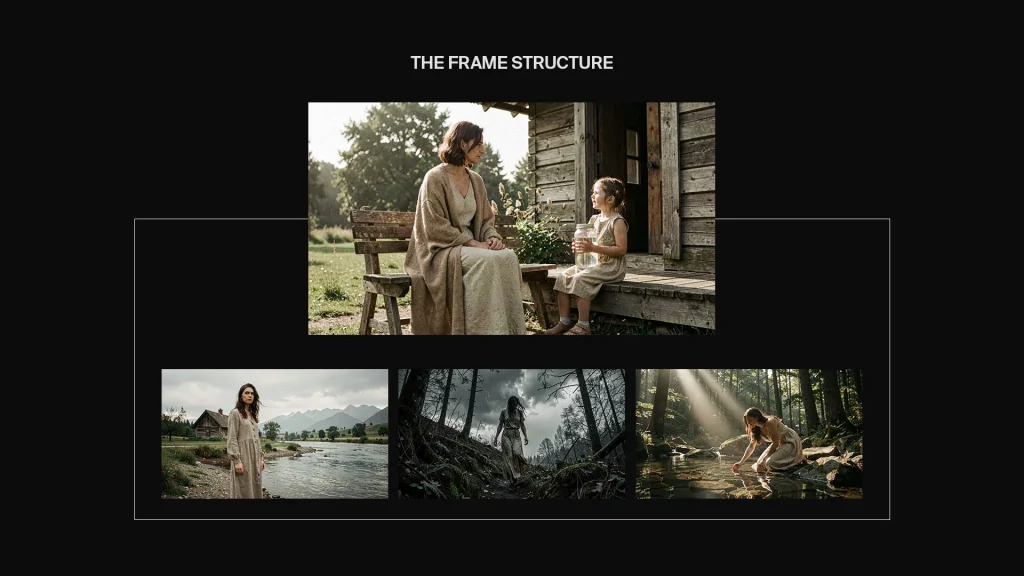
The frame: a story within a story
Now my favorite. We move the whole story one floor up: the woman, now old, sits with her granddaughter by the same river. On a shelf stands a jar of water. The granddaughter asks: grandma, why did you leave back then? And the grandmother tells the story.
Notice what happened. The stakes are no longer in the question "will she find the source"; we know she survived, she's sitting right in front of us. The stakes are in the frame: what the grandmother wants to pass on before it's too late. And in the finale the granddaughter takes the jar, walks to the river, fills it, and without knowing it, begins her own journey.
This is the mechanics of One Thousand and One Nights. The act of telling itself is the drama. Christopher Nolan goes even deeper in Inception: a frame within a frame, a dream within a dream within a dream, and behind every level you have to remember where you are right now. In campaigns, this structure can bind several spots together with a single narrator's voice. The frame on the outside, separate stories inside.
The Sufi parable: the point lands from the side
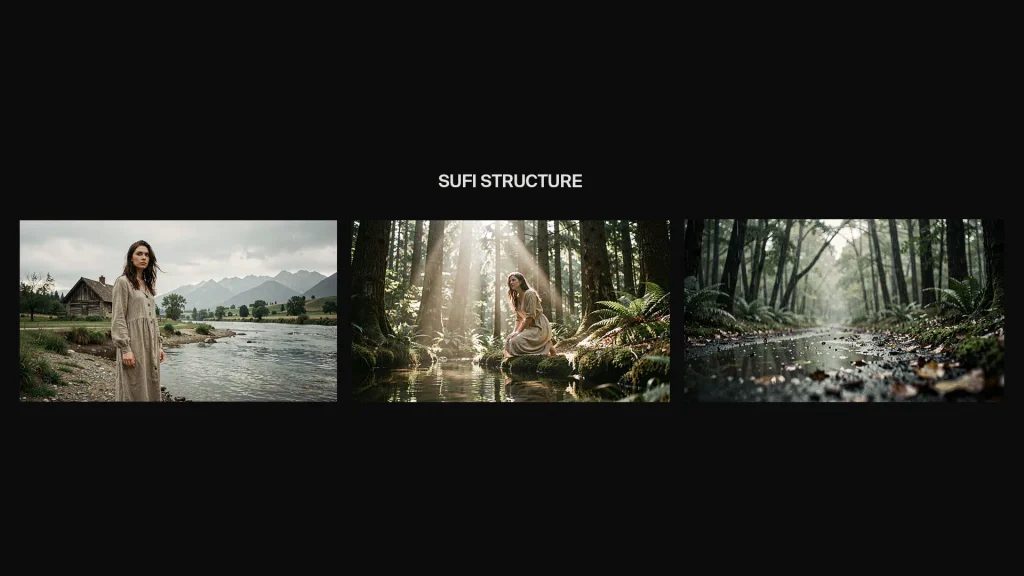
This is a technique known from Sufi teaching parables, the same tradition that gave us the stories of Mulla Nasreddin, the legendary sage and philosopher. It explains nothing; it shifts understanding to another level. The student receives insight, not a conclusion.
In our version:
The woman reaches the source and discovers that the water comes from rain, the same rain that falls over her own house. The source was beside her from the beginning. There is no resolution of a conflict here. There is a punchline that lands from the side and stays in your head for a long time.
Rashomon: truth as a riddle
And now we break certainty. A story in which one key event is shown from many different, often contradictory perspectives of the individual characters. The name comes from Akira Kurosawa's groundbreaking 1950 film Rashomon.
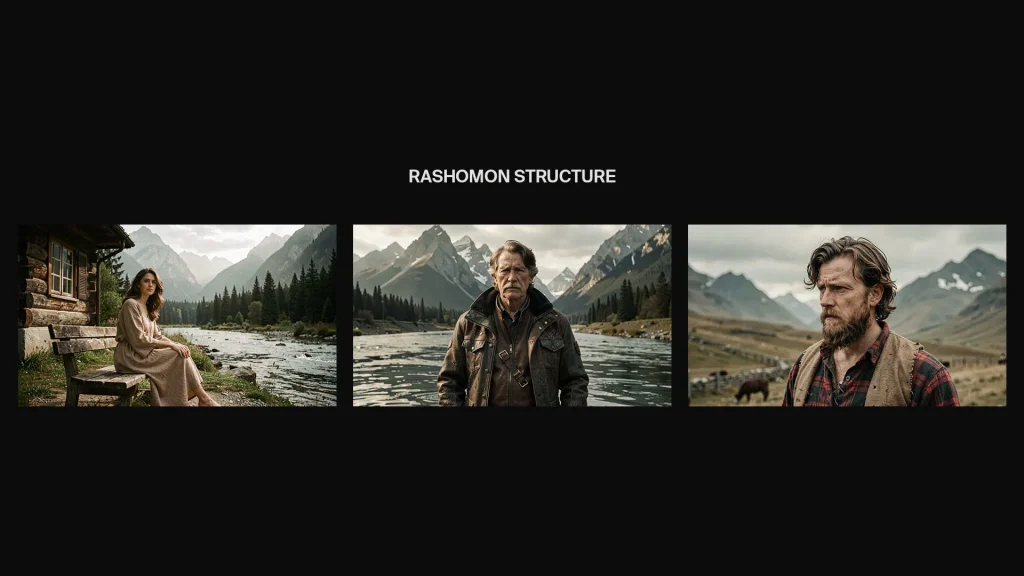
In our version, three people tell the same story:
The ferryman: "I talked her out of it; she turned back halfway."
The mountain shepherd: "She made it and wept with joy."
The heroine: "There is no source, there is only rain." The versions exclude each other and nobody gets to be right.
Kurosawa's structure does something no other can: the journey stops being the subject, and truth takes its place.
Backwards: Memento by the river
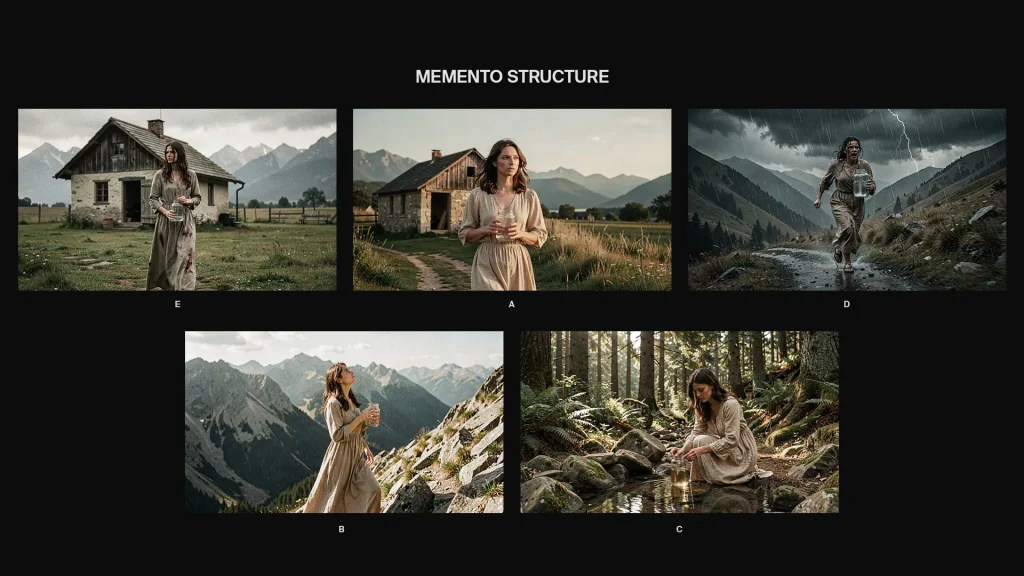
Finally, let's reverse the arrow of time and scramble it. We start from the end of the story, gradually revealing its earlier course, while weaving in scenes from the beginning, so that in the finale both timelines meet in the same place, the middle. If the structure is A-B-C-D-E, our scheme is E-A-D-B-C.
E. The woman returns home with a jar of water, exhausted, transformed. We don't know what happened. Evening.
A. The woman, calm, leaves the house with an empty jar. Morning.
D. The return with the jar, full of obstacles. Afternoon.
B. The walk upstream. Late morning.
C.The source, the climax. Noon.
Christopher Nolan built an entire film on this. In Memento we watch the beginning and the end of the same story at once: the color scenes run backwards, the black-and-white ones move forward, until both tracks meet halfway through the film in a B-D-A-C-E scheme. The viewer assembles the chronology themselves, in their head, shot by shot.
Chronology is a convention, not an obligation. Meaning can be assembled in reverse.
All the shapes
The point is not to throw the three-act structure away. The point is that it should stop being the default. Eight versions of the same story are eight different editing rhythms, eight different endings, all from a single sentence of plot.
Since I started doing this exercise, I read briefs differently. When a concept feels too obvious, I no longer wonder "how to tell it more beautifully." I ask: which structure has this story not been told in yet?